News
Q&A with The Mormoness co-editor, Michael Austin January 06 2016
Pre-order your copy today.
Q&A conducted with Michael Austin, co-editor. Ardis E. Parshall was not available at the time the questions were sent, but we will be hearing more from her on future volumes.
Q. What led to doing this series?
MA: The idea for the series came out of other projects. And it started with The Mormoness; or The Trials of Mary Maverick. I was doing a survey of the Mormon image in the 19th century for another book project, and I wanted to start with Russell’s book, which most of the literature cites as the first American novel to treat Mormonism in any way. And a fair number of Mormon critics labeled it an “anti-Mormon” book in the same vein as Boadicea, the Mormon Wife or Female Life among the Mormons. Two things happened when I went to read it. First, I could not find a readable copy anywhere. The only thing that my ILL librarian could pull up was a copy that had been printed from microfilm and xeroxed multiple times, with large areas of text that were completely unreadable. But I could read enough of it to see that it was not an anti-Mormon book at all, but was more sympathetic towards the Saints than almost anything written by a non-Mormon in the entire 19th century.
At the time, Ardis and I were working on another article together and were e-mailing back and forth nearly every day. I mentioned this to her, and, within a week or so, she was able to find an original copy of the book, transcribe it completely, and send it to me for use in my own work. We were both really impressed with the fact that one of the most historically significant works of literature about Mormonism ever published had all but disappeared from the world and that much of the scholarship about the book was inaccurate. That’s when we hit on the idea of a critical edition. This was around the time of spring break, so I took a few days off and drove to the Lincoln Library in Springfield, where all of John Russell’s papers are housed. Through his correspondence, I could see that he really was sympathetic to the Mormons and that he based The Mormoness on real events surrounding the Haun’s Mill Massacre that he had heard about directly from Sidney Rigdon and Parley P. Pratt, who stayed with him briefly after the Mormons were forced to leave Missouri. A critical edition seemed like the ideal way to share both the text and the context with modern readers.
And the more we talked, the more we realized that a lot of books by and about Mormons written in the 19th century have all but disappeared. This includes the sensational “dime novels” of the late 19th century, as well as some largely positive novels about Mormons by non-Mormons and some of the first attempts of Mormons to create their own literature in the Utah Territory. Ardis had done a lot of work with some of these novels, and I had recently begun haunting the archives in search of dime novels and penny dreadfuls. We realized that we already had enough source material for a pretty expansive series, and we felt that strong critical editions would serve the joint purposes of making material available that has not been available for years and giving this material a historical context that it has never had before.
Q: Beyond the literary value of these books, what other applications do you see these volumes being useful for?
MA: Much of this work will be just as interesting to historians as to scholars of literature. In fact, some of the work with the least literary merit has the greatest historical interest. Boadicea: The Mormon Wife, which will be the second volume in the series, will probably never be accused of literary greatness. But it has been written about by some of the top figures in Mormon History: Leonard Arrington, Terryl Givens, Sarah Barringer Gordon, Paul W. Reeve. All of them have been interested in Boadicea. And, not to say too much here, but the author of Boadicia has always been a mystery to scholars, and we are pretty sure that we have cracked it. We will be positing and making a case for authorship that nobody has ever made before.
Q: How does Mormon literature from the late 19th and early 20th centuries differ from Mormon literature of today?
MA: The literature of the 19th century had very little subtlety when it came to portraying Mormons. The overwhelming majority of volumes featured Mormon elders living in harems and forming Danite bands to hunt down and kill dissenters. And this was not just in the tawdry literature. Both Robert Louis Stevenson and Arthur Conan Doyle wrote novels that portrayed Mormons in these ways. And the books written by Mormons were just as bad in the other direction—they portrayed Mormonism as heroic and noble creatures unreasonably persecuted by a cruel and heartless world. Today, for the most part, both Mormons and non-Mormons are finding a more plausible middle ground.
Q: Most of the books in your series will be authored by non-Mormon writers. Why do you think non-LDS authors were interested in writing novels about Mormon characters?
MA: Mormonism was just about the most interesting thing that happened in America in the 19th century. A prophet finds golden plates in the ground and produces an epic of the history of Ancient America. He builds a huge following and founds one of the largest cities in the West. He is assassinated, and his people settle the barren wilderness. And somewhere in there, polygamy happens. These were amazing stories that people couldn’t get enough of. And Mormons fit very well into most of the standard tropes of the popular literature of the day—usually as the bad guys. I can’t imagine anything that could have captured the interest of more people for a longer time than the Mormons.
Q: Can you give us a tease for future volumes?
Well, here are some things that readers will encounter as the series progresses:
- A novella by a Mormon General Authority that was the basis for a stage play that ran briefly on Broadway.
- An anti-Mormon novel by an English writer that became part of a report written by one of the most famous British politicians of all time—as well as the basis for the most famous silent film about Mormons ever produced.
- A ghost story featuring a sympathetic Mormon character written by one of the attorneys who represented Homer Plessy in the famous Plessy v. Ferguson decision of the Supreme Court.
- A novel set in the great caverns below Salt Lake City that connect the homes of all Mormons to the Great Salt Lake.
- The full text of a famous monologue about the Mormons in Utah that was performed before sold out crowds at the Egyptian Hall in London in 1866.
And that’s just for starters.
Pre-order your copy today.
Year in Review and the Year Ahead December 29 2015
2015 was another amazing year for Greg Kofford Books! Here is a recap of the year and a look ahead to what is coming in 2016 and beyond.
Award-winning Publications
Several Kofford titles won awards from the Mormon History Association and the Association for Mormon Letters in 2015:
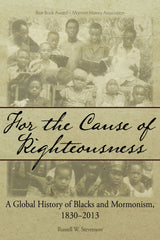 |
MHA Best Book Award For the Cause of Righteousness: A Global History of Blacks and Mormonism, 1830-2013 “Invaluable as a historical resource.” — Terryl L. Givens, author of Parley P. |
 |
MHA Best International Book Award Mormon and Maori “Unflinchingly honest yet unfailingly compassionate.” — Grant Underwood, |
 |
AML Religious Non-Fiction Award Re-reading Job: Understanding the Ancient World's Greatest Poem “A new gold standard for Mormon writings.” — Julie M. Smith, author, Search, |
All 2015 Titles
Here are all of the great titles that Greg Kofford Books published this past year:
 |
Mr. Mustard Plaster and Other Mormon Essays “Vibrant portraits of a kind and loving soul.” — Boyd J. Peterson, author of |
 |
Perspectives on Mormon Theology: Scriptural Theology Each essay takes up the relatively un-self-conscious work of reading a |
 |
Joseph Smith's Polygamy: Toward a Better Understanding “It is a book that will be read and discussed for years to come.” — Robert L. |
 |
Even Unto Bloodshed: An LDS Perspective on War “Indispensable for all future Mormon discussions of the subject.” — Daniel C. |
 |
William B. Smith: In the Shadow of a Prophet “Walker’s biography will become essential reading.” — Mark Staker, author of |
 |
Voices for Equality: Ordain Women and Resurgent Mormon Feminism “Timely, incisive, important.” — Joanna Brooks, co-editor of Mormon |
 |
Traditions of the Fathers: The Book of Mormon as History “Illuminating, prismatic views of the Book of Mormon.” — Mark Alan Wright, |
Looking Ahead at 2016 and Beyond
Here are a few eagerly-anticipated titles currently scheduled for the first part of 2016 and a look at what is in the works for the future:
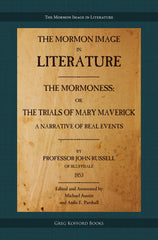 |
The Mormon Image in Literature Series The Mormoness; Or, The Trials Of Mary Maverick: A Narrative Of Real Events Published in 1853, the first American novel about the Mormons is also one of |
 |
The End of the World, Plan B: A Guide for the Future Environmental decline, political gridlock, war and rumors of war, decadence, |
Also forthcoming...
More volumes are in the works for our The Mormon Image in Literature, Contemporary Studies in Scripture, and Perspectives on Mormon Theology series.
Saints, Slaves, and Blacks by Newell G. Bringhurst, revised and updated
Lot Smith: Utah Hero, Arizona Colonizer by Carmen Smith and Talana Hooper
The Trek East: Mormonism Meets Japan, 1901-1968 by Shinji Takagi
Science the Key to Theology by Steven L. Peck
And much, much more...
Thank you for making 2015 exceptional and we are excited about 2016!
20% off all Kofford titles through the month of December! December 01 2015

'Tis the Season!
Greg Kofford Books is pleased to offer 20% off all titles ordered December 1st through December 31st. Simply enter "MERRY" into the discount code box at check-out to get your discounted price.
Orders placed by December 15th will have the highest likelihood of being received before Christmas. Customers living along the Wasatch Front can select the "pick-up" option during check-out to avoid shipping costs and pick up their orders directly from our office in Sandy, UT.
*Don't forget about our Twelve Days of Kofford daily book giveaway contests on Facebook running Dec 1st - 12th. Click here for details!
[FINISHED] Black Friday Sales: 30%-40% off all Book of Mormon titles! November 20 2015

40% off complete set of Second Witness (limited to first 100 sets)!
|
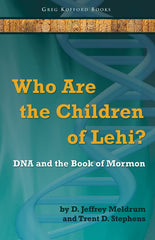
Who Are the Children of Lehi? “It may just cause you to think a little harder on the subject.” |
 |
Beholding the Tree of Life: “Breaks fresh ground in numerous ways.” |
|
Traditions of the Fathers: “For those who are teaching the Book of Mormon in Sunday School next year ... Gardner’s book is a tremendous resource. It’s informative, cogent, and altogether worth reading.” |
 |
The Gift and Power: “Contributes new and exciting research” |
 |
Second Witness: “No other reference source will prove as thorough and valuable |
 |
Brigham Young University |
EXCLUSIVE OFFER:
40% off the complete Second Witness 6 Volume series!
(limited to first 100 sets)

Second Witness, Volumes 1 - 6
Complete Set: $249.70 hardcover
$149.82 Sale Price
20% Off Sale on Women's Issues Books October 27 2015

With the recently published essays approved by the LDS Church on the topics of women and priesthood and the doctrine of Heavenly Mother, now would be a great time to read up on the conversations surrounding women in Mormonism.
Greg Kofford Books is pleased to offer 20% off the following titles beginning today through November 3rd when you type "ESSAYS" in the discount code box at checkout.

Mormon Women Have Their Say
Edited by Claudia L. Bushman and Caroline Kline
Sale Price: $25.56 + tax, paperback
(enter the word "ESSAYS" in the discount box at checkout)
From Claudia Bushman: Throughout the tangled past of the Church of Jesus Christ of Latter-day Saints, women have been active and vocal participants. Their journals and diaries, primarily from the nineteenth century, have been plumbed for evidence of their experience and attitudes. Less is known and written about contemporary Mormon women. LDS women today still live in a patriarchal society. What is it like for them? How to they respond to the Church they have joined or inherited? Can they make space for their interests? How do they envision their contemporary role in the Church? What are the issues that define their lives? Writing our own stories empower us. Many of these narrators do not normally speak out. This project preserves and perpetuates their voices and memories. The silent majority goes on record.
In light of the Gospel Topic essay "Mother in Heaven," readers would find the chapter, "Heavenly Mother," interesting as it explores the views and feelings of contemporary LDS women on this important theological topic.
Praise for Mormon Women Have Their Say:
“Mormon women have always had a lot to say, but generation after generation, their voices fade away. The problem is not just that archives and manuals favor the writings of male leaders. The real problem is that few of us know how to listen to seemingly common stories. We revere our sisters but don’t understand them. The essays in this volume go beyond collecting and preserving to the hard work of interpretation.” — Laurel Thatcher Ulrich, author of Well-Behaved Women Seldom Make History

Women at Church: Magnifying LDS Women's Local Impact
By Neylan McBaine
Sale Price: $17.56 + tax, paperback
(enter the word "ESSAYS" in the discount box at checkout)
From Neylan McBaine: This book is predicated on a single belief: that there is much more we can do to see, hear, and include women at church. In an effort to increase awareness of that belief and move all Church members to act on it, I have written this book as an inducement toward greater empathy for those who feel unseen, unheard, and unused, and a strategic guide to improving our gender cooperation in local Church governance. This book is for men and women who either are themselves engaged in this wrestle or know someone who is. It is for women who have been sitting on the sidelines of the media conversation around Mormon women, not sure where they fit or what they feel, but they resonate with at least some of what has been said. It is for the women who can't understand why someone would be discontent in the light of our glorious doctrine, but whose daughter or sister or friend or Relief Society sister may not be feeling so at ease.
Praise for Women at Church:
“A pivotal work replete with wisdom and insight. Neylan McBaine deftly outlines a workable programme for facilitating movement in the direction of the ‘privileges and powers’ promised the nascent Female Relief Society of Nauvoo.” — Fiona Givens, co-author of The God Who Weeps: How Mormonism Makes Sense of Life
Voices for Equality: Ordain Women and Resurgent Mormon Feminism
Edited by Gordon Shepherd, Lavina Fielding Anderson, and Gary Shepherd
Sale Price: $26.36 + tax, paperback
(enter the word "ESSAYS" in the discount box at checkout)
From Lavina Fielding Anderson: In larger Mormon society, I consider this book to be a third voice in an intensifying conversation. The first voice was that of Sheri Dew, president and CEO of Deseret Book, spelling out her position in Women and the Priesthood. The second voice followed a year later with the appearance of Neylan McBaine's Women at Church: Magnifying Women's Local Impact. This book, Voices for Equality: Ordain Women and Resurgent Mormon Feminism, is the third book in as many years to explore this disquieting, yet immensely significant topic. Broader in scope than either Dew or McBaine's works, it is data driven, using a combination of sociological and historical analysis, political and theological explorations, and sometimes wrenching personal experiences.
Praise for Voices for Equality:
"In these pages, some of Mormonism's finest researchers and thinkers bring a richness of historical and scholarly perspective and a powerful new survey of tens of thousands of Mormon people to bear on headline-making issues like women's ordination, sister missionaries, church discipline, the internet and faith, and change in the LDS church. This book is a much needed mirror for our time.” — Joanna Brooks, co-editor of Mormon Feminism: Essential Writings and author of The Book of Mormon Girl: A Memoir of an American Faith
SALE ENDS 11-3-15
LDS Theory of War in 3-Part Series October 08 2015

Kofford Books author Duane Boyce recently discussed the Mormon theology of war and violence in a three-part series at Meridian Magazine.
Boyce is the author of the Even unto Bloodshed: An LDS Perspective on War (2015), which has garnered the following praises:
“A careful and detailed argument against pacifism has long been needed, and it is hard to imagine someone doing a better job of it. The scholarship in this volume is impressive, and it is likely to be the definitive work on the subject for years to come. Truly a major accomplishment.” — K. Codell Carter, Professor of Philosophy, Brigham Young University
“Finally, we have a comprehensive and thorough discussion of war from an LDS perspective." — Royal Skousen, Professor of Linguistics, Brigham Young University, Editor, Book of Mormon Critical Text Project
In the first part of his series, Boyce discusses the question of pacifism vs. non-pacifism in LDS theology. He states:
"There are two fundamental views of war: pacifism, which argues that war cannot be justified and instead must be rejected as a matter of principle, and non-pacifism (of which just-war theory is an example), which argues that war is justified in certain circumstances.
It is easy to understand the appeal of both points of view. On one hand, all disciples of Christ detest violence; it is in the DNA of Christian embrace. And that gives pacifism a natural gravitational force: its appeal is both intrinsic and compelling. But an equally intrinsic and compelling influence in Christian DNA is the love of our families and of our brothers and sisters in general, and the obligation we feel to protect them from being brutalized and murdered.
The pull of these two moral forces creates a natural tension. The love of peace and the love of our brothers and sisters are both genuine, and both exert a natural influence on disciples of Christ. People end up leaning one way or the other, but it seems that everyone actually feels the pull of both.
The same tension seems to appear in the scriptures themselves."
Read part one: "Pacifism or Non-Pacifism? The First Great Question in Developing an LDS Theory of War."
In the second part of his series, Boyce examines the scriptural context of war:
"[One] view thought to support non-violence is the assertion that Book of Mormon wars occurred only because the Nephites were unrighteous. Every war they fought was completely unnecessary because the Lord promised Nephi that the Lamanites would never bother the Nephites if only the Nephites remained righteous (1 Nephi 2:23). We cannot, therefore, draw support for righteous conflict from the Nephites, since it turns out that the Nephites were always unrighteous when involved in conflict.
This claim, however—like the others—also appears to suffer when we examine the text more closely. It turns out that the Book of Mormon actually reports multiple occasions on which the Nephites suffered attack even though they were righteous—a feature of the record that straightforwardly disproves this categorical claim about them."
Read part two: "Do the Scriptures give us a Theory of War?"
In the third part of his series, Boyce discusses a theory of "just war" from an LDS perspective:
"Granted that the Lord abhors violence, what reason is there to think that he abhors all violence for the same reasons? Are all forms of violence the same? Do they all have the same moral character? Are the violence of a rapist and the violence of his victim the same? Do their violent acts have the same moral status? And are all forms of abhorrence-of-violence, then, the same?
And try this question. Why does scripture seem to countenance violence in some teachings/episodes and condemn it in others? Is there any reason to think the different cases and contexts are equivalent? Isn’t it more natural to wonder if there are differences between them and that that’s why they seem to teach different attitudes toward violence?"
Read part three: "Just War Theory and Key Gospel Texts"
Seer Stones and Translations: Brant Gardner's "The Gift and the Power" August 18 2015


On August 4, 2015, The Church of Jesus Christ of Latter-day Saints published photos for the first time of the seer stone Joseph Smith claimed to have used to translate the Book of Mormon, as well as the handwritten printer's manuscript of the book. While the photos and recognition of the seer stone may have been an exciting moment for those more acquainted with this aspect of early Mormon history, for others the appearance of the stone on their social media and news outlets may been unsettling--especially when the idea of the Prophet using such a stone seemed to counter the stories and portrayals of the translation process that they were more familiar with.
As a resource to perhaps help with some of the concerns, confusion, and questions that have arisen we would like to share a couple chapters from our 2011 publication, The Gift and Power: Translating the Book of Mormon. In this book, Brant Gardner explores all the pertinent issues and questions surrounding the translation of the Book of Mormon, including how Joseph's own cultural understanding contributed to his method of translation and why the book contains both Hebraisms, lengthy passages from the King James Bible, and anachronistic language and ideas.
Perhaps most intriguingly, Gardner explores in detail the phenomenon of the seer stone and provides a comprehensive theory as to why Joseph Smith thought a rather ordinary stone might be a tool to help him translate a book of scripture.
Gardner's meticulously researched and thought-provoking book is possibly the best published work available on the translation of the Book of Mormon.
Order the full book here.
Greg Kofford Books Authors at Sunstone July 27 2015
If you have the opportunity to attend this year's Sunstone Symposium (July 29 - August 1) at the University of Utah, check out the many sessions where Kofford authors are presenting papers and sitting on panels:

David Bokovoy, author of Authoring the Old Testament: Genesis - Deuteronomy, and Julie Smith, author of Search, Ponder, and Pray: A Guide to the Gospels will be part of a panel discussion to speak about world famous New Testament scholar John Dominic Crossan's "The Kingdom Mind: From Jesus to Paul and the Implications for Mormonism." This is the Smith-Pettit Lecture, Wednesday, July 29, Saltair Room.


- "Why the Heart Is As Important As the Brain: Combining New Science with Ancient Wisdom." Session 124, Thursday, July 30, 10:15 - 11:15, Panorama East Room.
- "The Environment: A Moral Issue For the Saints." Session 166, Thursday, July 30, 3:45 - 4:45, West Ballroom.
- "Sunday School Psychotherapy: Mormon Poets on Vulnerability and Madness, Healing and Hope." Session 173, Thursday, July 30, 5:00 - 6:30, Collegiate Room.
- "Transmormons." Session 226, Friday, July 31, 10:15 - 11:15, West Ballroom
- "Joseph Smith's First Vision: Imagery, Neurology, and the Construction of Memory." Session 261, Friday, July 31, 3:45 - 4:45, Saltair Room.


Josh will also present a paper entitled, "Foundational Murder: The Slaying of Laban," Session 273, Friday, July 31, 5:00 - 6:30, Collegiate Room.


Response to Concerns Regarding Voices For Equality: Ordain Women and Resurgent Mormon Feminism July 14 2015
On July 29th, 2015 Greg Kofford Books will publish Voices For Equality: Ordain Women and Resurgent Mormon Feminism. The book consists of essays from scholars and activists on the rise of the Ordain Women movement and the Mormon feminism (past and present) out of which it was born.
Recently there have been various concerns regarding the content of the book. The editors of the volume have provided this written response:
Concerns being expressed here are very understandable. We regret our book’s oversight in terms of both coverage and contributors, as noted previously. In retrospect, it’s clear that we could and arguably should have extended our search for authors outside the network of our personal acquaintances who could very appropriately have enlarged the framework of our book by addressing the linkage between feminist issues and Mormon PoC, as many of you have pointed out. Having said this, it’s also fair to say that the very last thing we imagined accomplishing was to insult, devalue, or marginalize any Latter-day Saints with heartfelt grievances concerning their institutional treatment in the LDS faith. Its limitations notwithstanding, we believe Voices for Equality is an honest book—the product of conscientious intent and shared intellectual labor by both devoted women and men of good will—with the goal of contributing something of value to the seminal issue of gender equality in contemporary religion. We hope this modest goal will be achieved—in spite of any retrospective regrets we may have—and we invite you to read it before you judge our limitations too harshly. Give us your feedback after reading Voices for Equality. We would very much welcome that.
Gordon Shepherd, Lavina Fielding Anderson, Gary Shepherd
As the publisher of Voices For Equality, we at Greg Kofford Books also affirm that, despite these serious lapses, we believe the book does make a valuable and unique contribution toward understanding the struggle for gender equality in contemporary religion. However, we express our deep regret that no Mormon woman of color has a voice within its pages, and we sincerely apologize to any who were hurt or dismayed by this oversight, but especially to Mormon women of color themselves. The subject matter of the book is not simply "Ordain Women," but the larger Mormon feminist community, and the book should have reflected that reality. Though we cannot immediately make full restitution for this omission--the book is too far along in the publication process--we hope to further address this concern in our second printing of the volume. We have published several books on figures, histories, and issues directly pertaining to Mormon people of color, and, in the past, have solicited essays from people of color within the Mormon community and we remain eager to consider for publication any such manuscript that is presented to us.
Greg Kofford Books has sought to be the premier publisher in Mormon studies titles. We have published a wide range of books covering everything from Mormon history, philosophy, and theology, to scripture, science, social issues, and personal essays. However, one of the problems with Mormon studies is that the various areas of academic emphasis don't commonly speak to one another, or do not seem aware of one another--a problem that all too often plagues academic scholarship in general--and this is often reflected in or is a result of the very communities that academics seek to study.
In other words, as much as Kofford Books has genuinely sought to be a leader in fearlessly publishing scholarship on ideas and issues that matter to Mormons, in this case we have simply failed to be such. We have a long way to go, and we are willing and eager to listen to and learn from those whose ideas, histories, and people have not received the attention they deserve, and respond with what resources are available to us. We hope you'll bear with us and remain partners with us on this journey to better understand, develop, and make available the ideas that matter so much to the Mormon people.
Sincerely,
Greg Kofford Books Staff
Preview Traditions of the Fathers: The Book of Mormon as History July 09 2015
Traditions of the Fathers: The Book of Mormon as History
Preorder the volume here.
Preview Voices for Equality: Ordain Women and Resurgent Mormon Feminism July 07 2015
Voices for Equality: Ordain Women and Resurgent Mormon Feminism
Preorder the volume here.
Q&A with Voices for Equality Editors June 23 2015

Voices For Equality: Ordain Women and Resurgent Mormon Feminism
Edited by Gordon Shepherd, Lavina Fielding Anderson, and Gary Shepherd
Approx. 425 pages
Paperback $32.95 (ISBN 978-1-58958-758-8)
Pre-order your copy here.
Q: What led the three of you to this project? How did it come together with so many authors?
Gary Shepherd: Lavina, of course, is a long-time Mormon feminist who has been at the forefront in challenging the LDS Church to re-examine traditional assumptions about a variety of issues and to become a more open, flexible, and tolerant organization. Gordon and Gary have written about processes of change in Mormonism and the LDS Church for over 30 years, and specifically predicted in their first co-authored book, A Kingdom Transformed (University of Utah Press, 1984), that women’s status would become a major issue in the church in the decades to come. When OW first began to stir publicity for its cause in March of 2013, Gordon and Gary saw an opportunity for first hand sociological observation of what promised to be a potent new expression of LDS women’s movement towards status equality with men. The three of us were well- acquainted from many years of overlapping scholarly involvements and agreed that a book that drew from a wide spectrum of Mormon scholars and activists on this subject could be an important stimulus for a larger, constructive discussion within LDS circles on the prospects for change. Lavina was especially well-connected with key people involved in both OW and Mormon feminism generally, and we were able to successfully tap into her network for authors who could address the various issues we thought were important.
Q: Who are the intended audiences for this book? What do you hope each get out of it?
Gary Shepherd: We hope the book will particularly have wide enough appeal to attract a general, lay LDS readership. Many LDS members know only what they read and see in media sources about Mormon feminist goals and their rationale, or what they hear in church from both leaders and ordinary gossip. At the same time, Mormon women tend to be uncommonly well-educated, especially younger generations, and their personal experience in contemporary secular society—in school, careers, organizations, and every other arena of social life—fosters increasingly taken-for-granted assumptions about their equality with men. When these assumptions are not institutionally applied within the LDS religious realm, it must cause some degree of dissonance and at least private musing about the causes, consequences, and possible resolutions of this significant discrepancy. So this is the first audience we hope will be reached, at least enough to provide an impetus for further personal reflection and conversation with family, friends, and colleagues.
Otherwise, there is enough of a scholarly approach taken in many chapters of the book to certainly appeal to Mormon intellectuals, academics, and scholars. For those among these categories who are themselves committed in various ways to advance gender equality in the Church, we think this book will help crystallize views and perhaps serve as a catalyst for more effective efforts to bring about change through writing, speaking, discussion, and assignment of the book as a text in Mormon studies courses.
Q: This book appears at a time when social media and podcasting have soared in popularity as perhaps the primary ways, especially among young people, to communicate about people, events, and ideas. How does an academic book like this fit into that crowd? Can it say and do things that these other forms of communication cannot?
Gary Shepherd: Yes, certainly. As you note, we have brought together a relative large and diverse set of authors—some activists, some scholars—in one place—this book—and have solicited and organized their diverse, expert, well-reviewed, written contributions around a set of pre-planned, coherent topical subjects. We don’t think you can easily get this kind of all-in-one-place coherent, quality education from popular social media sources.
Q: The title of your book, Voices for Equality: Ordain Women and Resurgent Mormon Feminism implies that in Ordain Women there is both an intimate connection but also possibly a significant divergence from prior iterations of Mormon feminism. Is this the case? And if so, how?
Gary Shepherd: Ordain Women is not exclusively a younger generation movement, but certainly many of the leaders are of a younger generation (e.g, 20-40 or so years of age), and many of the women (and men) who have posted OW Profiles on-line are also younger. These are the generations mentioned above who take-for-granted gender equality in a modern, secular world and yet experience its absence in the realm— religious and spiritual—that for many is most important to them. They are action oriented, more prone to speak directly to power, and are genuinely committed to bringing about the gender equality they see lacking in their church within their own lifetime. At the same time, OW would not even exist without the conceptual framework and organizational foundations established by second wave Mormon feminists in the 1970s, 80s, and 90s and the steps they took to challenge established patriarchal traditions through their persistent and persuasive writings and personal witness. And, in fact, several of the founding and continuing leaders of OW are older Mormon feminists who have never stopped working for change and are grateful to see that their earlier contributions are now being incorporated into this new, energetic, and concrete activist expression of hope for reform. This intimate connection you speak of between prior expressions of Mormon feminism and current OW activists is, in fact, one of the points strongly made in several chapters of Voices.
Q: In the preface to the book, Lavina writes that she considers this volume to be the third literary voice in an intensifying conversation about women in the LDS church, along with Sheri Dew's Women and Priesthood, and Neylan McBaine's Women at Church: Magnifying LDS Women's Local Impact. Tell us more about this dynamic and how Voices for Equality makes its contribution.
Gary Shepherd: Simply that Dew’s position—although perhaps had it been given voice several decades ago would likely have been perceived as quite liberal for simply discussing issues of equality—currently occupies the most conservative end of the contemporary continuum. McBaine’s book occupies middle ground, advocating changes that give women more recognition and participation opportunities in worship and ecclesiastical affairs but not fundamentally moving LDS women into the same sphere of equality within the Church that they claim as their intrinsic right in the larger world. It is movement into this ultimate sphere that of course OW advocates. Our book, represented by a diverse set of authors, is not unanimous in its endorsement of OW strategies and goals or single-minded in its preoccupation with OW per se. But anyone who reads our book in its entirety with an open mind should at least be forced to re-examine prior assumptions and begin thinking more clearly and systematically about the values and changes that Mormon feminists are so earnestly and persuasively advocating.
Q: There are a variety of methodological approaches you and the various authors have taken in documenting and narrating the phenomenon that has been Ordain Women within the wider context of Mormon feminism. Tell us a little about these various approaches and how they contribute to our understanding of these events, people, and ideas.
Gary Shepherd: No issue of broad social scope can adequately be comprehended by a single method or point of view. There is always a historical, social, and cultural context within which every current concern is embedded. So we have solicited historians to identify and narrate the complex of interrelated events that generated both original Mormon feminism and subsequently OW. We have solicited sociologists, psychologists, and anthropologists to explore both past and present patterns of social interaction and cultural meaning that give shape and substance to Mormon feminism and OW and reveal the nature of conflict between these movements and the established institutional authority and traditions of the LDS church. Theologians have helped us to understand the rationale behind authoritative proclamations of belief, doctrine, and religious practice and how, within these proclamations, there is ground for change and reinterpretation. And, importantly, individuals who have made history by engaging with others in thought, hopeful prayer, organizational participation, and direct action are drawn upon to provide accounts of their own lived experience.
Q: How do you see Voices for Equality positioned within the wider universe of Mormon feminism and questions revolving around Mormon women? What might you hope to see in the future as far as scholarship on these subjects is concerned?
Pre-order your copy now.
Greg Kofford Books Award-Winning Titles June 12 2015
Since its first publication in 2001, Greg Kofford Books has established a reputation as a publisher of consistently award-winning titles in Mormon history and literature. Check out this comprehensive list of each of our books that has received an award:

2015 Best Book Award, Mormon History Association:For the Cause of Righteousness: A Global History of Blacks and Mormonism, 1830-2013, by Russell Stevenson.
2015 Best International Book Award, Mormon History Association: Mormon and Maori, by Marjorie Newton.
2014 Best Religious Non-fiction Award, Association for Mormon Letters: Re-reading Job: Understanding the Ancient World's Greatest Poem, by Michael Austin. 
2014 Best International Book Award, Mormon History Association: From Above and Below: The Mormon Embrace of Revolution, 1840-1940, by Craig Livingston.
2013 Best International Book Award, Mormon History Association: Tiki and Temple: The Mormon Mission in New Zealand, 1854-1958, by Marjorie Newton. 
2012 Best Biography Award, Mormon History Association: Swell Suffering: A Biography of Maureen Whipple, by Veda Tebbs Hale.
2011 Best Criticism Award, Association for Mormon Letters: The Gift and Power: Translating the Book of Mormon, by Brant Gardner. 
2011 Best Book Awards, Mormon History Association and John Whitmer Historical Association: Hearken O Ye People: The Historical Setting of Joseph Smith's Ohio Revelations, by Mark Staker. 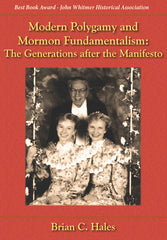
2007 Best Book Award, John Whitmer Historical Association: Modern Polygamy and Mormon Fundamentalism: The Generations after the Manifesto, by Brian Hales. 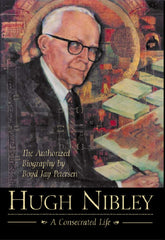
2003 Best Biography Award, Mormon History Association: Hugh Nibley: A Consecrated Life, by Boyd Petersen.
Kofford Authors Win Best Book, Best International Book Awards at MHA June 05 2015

This is Kofford's second Best Book Award, after Mark Staker's 2011 win for Hearken O Ye People: The Historical Setting of Joseph Smith's Ohio Revelations, and our third consecutive Best International Book Award, after Marjorie Newton's Tiki and Temple: The Mormon Mission in New Zealand, 1854-1958 in 2013, and Craig Livingston's From Above and Below: The Mormon Embrace of Revolution, 1840-1940 in 2014. (Kofford has also won Best Biography for Boyd Petersen's Hugh Nibley: A Consecrated Life in 2003, and Veda Tebbs Hale's Swell Suffering: A Biography of Maureen Whipple in 2012).
Kofford Authors at MHA June 01 2015
Greg Kofford Books authors have long been well-represented as speakers and panel chairs at annual conferences of the Mormon History Association, and the 2015 Conference at the Utah Valley Convention Center in Provo, Utah, June 4-7, is no exception! Check out the titles of their presentations and panels below:


Russell Stevenson, author of For the Cause of Righteousness: A Global History of Blacks and Mormonism, 1830-2013 will present, "We Aren't Africa: Mormonism in Nigeria, 1960-1964."
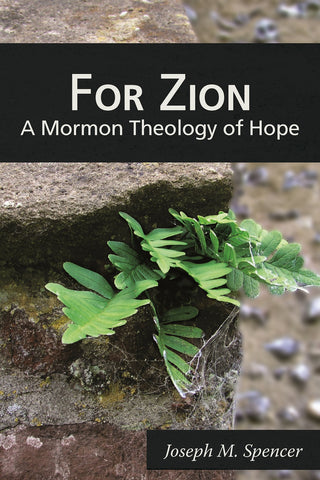

Joseph Spencer, author of For Zion: A Mormon Theology of Hope will present, "Canon and History: On the Revelation to Emma Smith."
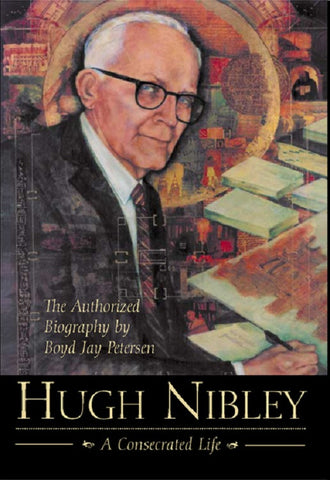


Boyd Petersen, author of Hugh Nibley: A Consecrated Life and Dead Wood and Rushing Water: Essays on Mormon Faith, Culture, and Family will chair theTheology and History panel.


Claudia Bushman, co-editor (with Caroline Kline) ofMormon Women Have Their Say: Essays from the Claremont Oral History Collection will present "Early Decisions," as part of the Exponent II: Present at the Creation panel.


Lavina Fielding Anderson and Newell Bringhurst, editors of Excavating Mormon Pasts: The New Historiography of the Last Half Century will chair a panel and present a paper, respectively. Lavina will chair the Mormon History Journals Editors panel, and Newell will present "President David O. McKay's 1954 Encounter with the LDS Church's Black Priesthood Ban: An Important but Forgotten Episode."


Thomas Alexander, author of Mormonism in Transition: A History of the Latter-day Saints, 1890-1930, 3rd ed. will speak as part of the Culture of the Early Mormon History Association roundtable.


Todd Compton, author (with Leland H. Gentry) ofFire and Sword: A History of the Latter-Days Saints in Northern Missouri, 1836-39 will present "Ganado Mucho, Navajo Headman, and the Mormons."


Don Bradley, author of the forthcoming The Lost 116 Pages: Rediscovering the Book of Lehi will present, "From Cumorah's 'Ark' to Joseph's Hat: Sacred and Mundane Objects in the Emergence of the Book of Mormon."

Christine and Christopher Blythe, editors of the forthcoming Mormonisms: A Documentary History, 1844-1860 will chair panels and present papers. Christine will present, " 'Presiding at Birth:' The Creation of Folk Theologies among Latter-day Saint Women," and she will chair the Mormonism and Material Culture panel. Christopher will present, "Martyrdom Canes and Vernacular Mormonism" in that same panel.


Stuart Parker, author of the forthcoming History through Seer Stones: A Hundred Years of Mormon Pasts will present, "Margarita Bautista's 'Eternal Mexico:' A Revolutionary Mormon proto-Chicanismo."
Q&A with William B. Smith Author Kyle Walker May 20 2015

William B. Smith: In the Shadow of a Prophet
by Kyle R. Walker
Approx. 650 pages
Paperback $39.95 (ISBN: 978-1-58958-503-4)
Hardback $69.95 (ISBN 978-1-58958-504-1)
Q: What prompted your interest in William B. Smith as a biography subject?
Kyle:I have been researching extensively on the Joseph Sr. and Lucy Mack Smith family for many years, and William has always fascinated me. Perhaps it is because of my training as a marriage and family therapist that his life has intrigued me so much. I enjoy researching and studying about family dynamics in a historical context. I was also drawn to this subject because of the vast surviving letters and sources that I knew would help to reconstruct his life. Besides his autobiography that he published in 1883, there are literally hundreds of his letters that have survived. After his break with Brigham Young in September 1845, he affiliated with a host of noted dissidents, and attempted to form his own offshoot of Mormonism. All of these interactions provide rich material from which to reconstruct his life.
Q: There have been full length biographies of several prominent Mormon figures over the years, but we had to wait until 2015 to get the first full length treatment of William Smith, the Prophet's younger brother, member of the Quorum of the Twelve Apostles, and Church Patriarch. Do you think there a specific reason for this?
Kyle: I think it was because both the LDS and RLDS Churches tried to distance themselves from William. The LDS Church distanced themselves because he left the Church, taking to the press with his remonstrations, and tried to interfere with many of their pursuits, including their efforts for statehood. The RLDS Church chose to distance themselves from William after his death because of his previous involvement with polygamy. For these reasons, his life has largely been left in the shadows.
Q: What were some of the more difficult challenges you encountered in researching and writing this volume? Is there anything specific to the subject matter or Mormon history that presented difficulties?
Kyle: The most difficult thing was sifting through the sources to try and glean insights into William’s challenging personality. While I tried not “diagnose the dead,” I think the reader will be able to identify some of William’s core insecurities that drove his behavior, as well as his impulsive temper which led to extensive conflict in his relationships. Sorting out his form of plural marriage and documenting his wives was also a challenge.
Q: How might LDS readers specifically benefit from this biography of Smith?
Kyle: I think they will gain a greater appreciation for William’s contributions to both Mormon and our nation’s history. He was a member of the original Quorum of the Twelve, converting hundreds to the faith, edited two Church-sponsored newspapers (The Wasp and The Prophet), and served as Church Patriarch. In addition, he served in the Illinois House of Representatives from 1842-43, defending Nauvoo’s controversial charter. He also served as a Union soldier in the Civil War in 1864-65.
Q: How does Smith's story contribute to our understanding of the dynamics of the Joseph and Lucy Smith family?
Kyle: I think they will gain a greater appreciation for the first family of Mormonism, and some of the challenges they experienced in raising and dealing with William’s difficult personality. I think studying his life allows for a new perspective in understanding the Smith family, most especially after the deaths of Joseph and Hyrum. As the only surviving male member of that family after the summer of 1845, William’s perspectives and behavior had a profound influence on surviving family members.
Q: Tell us a little about William's relationship with Joseph Smith.
Kyle: His relationship with Joseph Smith was actually more positive than most people think. Despite their fist-fight that occurred in 1835, they had a close and supportive relationship. William struggled with being a subordinate in all his relationships, and it was, at times, also difficult for him to defer to his brother’s judgment as both President of the Church and as an older sibling. Joseph continually supported William in his calling as an apostle, even when other members of the Twelve did not. There were times when Hyrum and Joseph intervened on his behalf in order to bring reconciliation between William and the rest of the Twelve.
Q: Smith was an apostle at the time of his brother Joseph's death, but he was excommunicated from the Church soon after. What prompted this seemingly drastic turn of events?
A: Well, I basically dedicate four chapters of the book trying to explain why he broke with the Twelve. It was a gradual and complex process, but he ultimately felt like he should hold a loftier position in the Church’s governing councils, similar to the one Hyrum held before his death. He also felt that it was his prerogative to utilize the sealing power without authorization. It was something the remainder of the Twelve were unwilling to allow.
Q: We know that William Smith eventually affiliated with the Reorganized Church (now the Community of Christ), led by his nephew, Joseph Smith III. Did William have any significant influence in church affairs?
Kyle: While William continually shared his views through letter-writing, which Joseph III often published in the Saints’ Herald newspaper, Joseph III astutely kept him at a distance from any real governing authority. But that did not prevent William from regularly petitioning his nephew for a more prominent role in the RLDS Church hierarchy.
Q: Did Smith have any substantial contact with the LDS Church during this time and before the end of his of his life?
Kyle: Yes. He petitioned to be reinstated in the LDS Church at least six times after he broke with Brigham Young’s leadership. However, he was unwilling to make the concessions that Orson Hyde (representing the Twelve) stipulated. His petitions to LDS leaders were often laced with requests for financial support, and always with the demand that he be reappointed as an apostle and as Church patriarch. He wrote to Brigham Young each year from 1854-1856 desiring reconciliation. Probably because of William’s continued demands, Young did not reply to any of these letters. Smith was rebaptized in 1860 by a traveling LDS missionary without the Twelve’s authorization, but that was short-lived. He shortly afterward turned to the RLDS Church.
Pre-order your copy here.
Q&A with Even unto Bloodshed author Duane Boyce May 19 2015
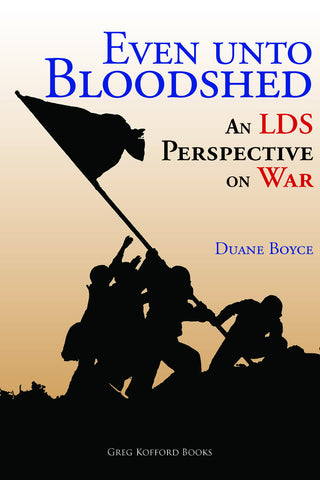
Even unto Bloodshed: An LDS Perspective on War
by Duane Boyce
322 pages
Paperback $29.95 (ISBN 978-1-58958-630-7)
Available May 26th in print and e-book
Preview Even unto Bloodshed here.
Q: What prompted you to begin writing this book?
Duane: Nothing is sadder than war, and yet nothing seems more common. Although it is tempting to just sit back and hope conflict will go away, there is really no hope for this. And that means disciples of Christ, in particular, must be extremely thoughtful on the subject. Is war ever permitted? If not, why not? And if it is, under what circumstances? What can possibly justify the devastation and human misery entailed by military conflict?
It is not difficult to find a multitude of mortals’ opinions on such matters, but for followers of Christ this is far from the main concern. Ultimately, to whatever degree we can discover it, we want to know the Lord’s own disposition toward violence and to embrace that. And that means we want to search the scriptures with care and to bring to bear every relevant consideration. We cannot assume that the matter is simple and that it can be settled with a quick verse or two. It seems to me that the issues are more complicated and subtle than that. That’s why my study led to a book rather than to an essay.
Q: A broad readership is always the most desirable, but is there also an intended audience for this book? And what do you hope they get out of it?
Duane: At some point, almost everyone becomes intensely interested in the moral evaluation of war. It’s hard to say when that will happen, but I think most people face it at some point. This book is for anyone who decides it’s time to consider the matter comprehensively, from a gospel point of view. Comprehensiveness seems important to me. After all, it’s not hard to have a couple of passages in mind that seem to settle the question of war, but the problem is that others can have a different set of passages in mind that, to them, settle the question in a different way. I think many would find it helpful to read a book that tries to approach the matter more comprehensively than that.
In my view, all the relevant scriptural passages cohere in a unified framework about war. They actually don’t compete but genuinely synchronize in their collective illumination of this gospel topic. Anyone interested in how this is possible will be interested in this book. Or so it seems to me, at any rate.
Q: In this book you argue that the position of the pacifist is not tenable, either on secular or scriptural grounds. Why might a Christian be drawn to pacifism, and, conversely, why might another Christian be drawn to non-pacifism?
Duane: All disciples detest violence. It is in the DNA of Christian embrace. And that gives pacifism a natural gravitational force: its appeal is both intrinsic and compelling. But an equally intrinsic and compelling influence in Christian DNA is the love of our families, and of our brothers and sisters in general, and the obligation we feel to protect them from being brutalized and murdered.
The love of peace and the love of our brothers and sisters are both genuine and both exert a natural influence on disciples of Christ. People end up leaning one way or the other, but I think everyone actually feels the pull of both. Given the set of choices, the result is a genuine psychological and spiritual tension. Who doesn’t feel it?
Q: You spend a good deal of time in the book outlining "Just War Theory," a concept first articulated in the Christian tradition by St. Augustine as an attempt to describe the criteria that must be present in order for Christians to morally participate in war. Can you briefly explain how this might or might not intersect with LDS beliefs? Do LDS need Just War Theory in order to understand how to engage in war in the present time?
Duane: Just-war theory is valuable for two reasons. First, in any comprehensive look at war, it is important to consider secular arguments as well as spiritual ones. Just-war theory is a natural starting place because, as far as it goes, it captures most people’s intuitions, and is very helpful. Second, because its origins are Christian, its principles are not uncongenial to a Christian point of view and therefore the theory is relevant to any consideration of an LDS approach. To the degree it is possible to create an LDS framework about war, just-war theory can help in thinking about it.
Q: Where do you see this book being positioned with regard to the ongoing conversation concerning LDS perspectives on war and peace? What original contribution does this book make to that conversation?
Duane: Given the tension identified previously, it is only natural that positions will coalesce around one pole or the other. The focus will be either on the evil of violence or on the necessity of defending human beings from brutality and murder. Both are legitimate, of course, so the real question is how to address both matters within a single conceptual frame. What point of view can give full weight to both considerations and simultaneously remove the tension between them? Creating that kind of frame is the purpose of this book.
Q: If a person holds non-pacifist beliefs regarding war, does that mean such a person is "pro-war?" What are some of the elements of your position that you think pacifists misconstrue or misunderstand? Can the same be said for non-pacifists' understandings of pacifism?
Duane: As to the first question: Stated this broadly, it seems to me impossible for a disciple to be “pro-war.” A fundamental hatred of violence is a property of discipleship, and this means the proper default position is always one of vigorously resisting war as a solution to problems.
As to the second and third questions: I think mutual misunderstanding is unavoidable given the tension between detesting violence and loving those suffering from aggression. Whichever way we lean, it is easy to conclude that those on the other end just don’t appreciate what we appreciate. That’s why people with different views can be impatient with each other. It’s easy to see others as blind to what really matters. In my view, both really matter and no approach to war can be satisfactory if it does not give full weight to both.
Q: Having devoted a lot of time to thinking about war and peace with regard to Christian discipleship, what would you say is the problem most difficult for Latter-day Saints to wrestle with?
Duane: The most difficult problem is the tension I’ve mentioned. It occurs not only in our hearts, but in the scriptures themselves, which at times seem to prohibit violence and at other times to promote it. This seems contradictory. Are the scriptures themselves disconnected? It can seem as if they are, and, if so, we then seem doomed either to flip-flop between the competing views or to settle permanently for one but at the cost of minimizing the other. None of this seems satisfactory. Disconnected scriptures? Spiritual flip-flopping? Permanent underestimation of a legitimate scriptural perspective?
Fortunately, I think all of this unnecessary. In my view, the tension actually rests on a mistake. When we frame the issue more carefully it turns out that scriptural teachings about war fit together perfectly and they do so without minimizing anything. Appreciating the gospel message at a deeper level, the tension at the surface evaporates. To me the reasons for all of this are both fascinating and highly illuminating. It takes a book to show it (at least if we want to attempt anything close to comprehensive), but if I am right that the result is the removal of a common spiritual tension, the effort has been worth it.
Pre-order your copy here.
Preview William B. Smith: In the Shadow of a Prophet May 07 2015
William B. Smith: In the Shadow of a Prophet
Preorder the volume here.
Recent Reviews of Kofford Books Titles April 30 2015
Kofford titles continue to receive major accolades in the Mormon academic community. A few highlights from the past couple months:

For Zion: A Mormon Theology of Hope, by Joseph M. Spencer
- “It deserves to be read widely, and the message of consecration deserves discussion in Mormon sacrament meetings, Sunday schools, and General Conferences” —Association for Mormon Letters
- “Those interested in and familiar with Mormon theology will find this a refreshing read...Spencer’s book adds freshness and credibility to the literature, and his contribution to this topic is noteworthy.” —BYU Studies
- "What Spencer’s book drives home (and is all the reason for reading this remarkable book) is the invaluable insight that our hope in the future transformation of the world is made most evident in our loving answerability for its present circumstances." --BYU Professor of Humanities George Handley

- "I think this is now the primary scholarly treatment of the LDS race and priesthood history." — Times and Seasons
- "Stevenson should be commended writing the best resource for Latter-day Saints to learn more about the experience of Mormon blacks in settings both American and international...For the Cause of Righteousness is the best one-volume history of blacks and Mormonism available anywhere." — Juvenile Instructor: A Mormon History Blog
- “For the Cause of Righteousness” is an indispensable and long overdue volume — not only for its content, but also in the way it presents Mormon history. Stevenson’s book crucially shifts away from both the typical top-down leadership narrative, and the “outsider’s” perspective of Mormon racism. Exploring the priesthood ban in the framework of a global community better explains the interaction between blacks and Mormons. Significantly, this work illuminates the average Latter-day Saints’ role in shaping the faith—not as submissive sheep, but as movers and shakers." -- Association for Mormon Letters

- "Toward a Better Understanding" is warmly recommended for anyone who wants to learn more about Joseph’s plural marriages but particularly to those just venturing into its sometimes choppy waters. Were I not vulnerable to the sin of envy, I’d wish I had written it." -- Gregory L. Smith, Interpreter: A Journal of Mormon Scripture
- "I enjoyed this book and found it very helpful...The book allowed me to understand the relationships between events more clearly than I have before. I found the book to be faith-affirming and a further testimony of Joseph Smith’s life as a prophet of God. I would recommend it for those struggling with the topic as well as those who want to know more so they can be prepared for questions from others." --Suzanne Long Foster, Interpreter: A Journal of Mormon Scripture
- "Joseph Smith’s Polygamy: Toward a Better Understanding is an excellent and essential volume that will not only answer questions and offer solace to “truth seekers [who] may encounter details that are uncomfortable when studying early polygamy” but will also be a useful and interesting volume for those who have spent years studying the subject. I wholeheartedly recommend this book to all." --Craig L. Foster, Interpreter: A Journal of Mormon Scripture

Re-Reading Job: Understanding the Ancient World's Greatest Poem, by Michael Austin
Michael Austin received the 2014 Award for Best Religious Nonfiction from the Association for Mormon Letters, for his book, Re-reading Job: Understanding the Ancient World's Greatest Poem. -- Association for Mormon Letters
Preview Even unto Bloodshed: An LDS Perspective on War April 29 2015
Even unto Bloodshed: An LDS Perspective on War
and then pre-order* your copy today.
with purchase of Even unto Bloodshed.
Preview Joseph Smith’s Polygamy: Toward a Better Understanding April 09 2015
Joseph Smith’s Polygamy: Toward a Better Understanding
and then pre-order your copy today.
Q&A with Joseph Smith's Polygamy authors Laura Hales and Brian Hales April 06 2015

Joseph Smith's Polygamy: Toward a Better Understanding
by Brian C. Hales and Laura H. Hales
223 pages
Paperback $19.95 (ISBN 978-1-58958-723-6)
Available April 14th in print and e-book
Q: The last few years we've been inundated with new information concerning Mormon polygamy, from podcasts about polygamy, to the Church posting an essay on the subject, to Brian's 3 volume set on the history and theology of polygamy in early Mormonism. How does Joseph Smith's Polygamy: Toward a Better Understanding fit into that landscape and contribute to this ongoing conversation?
Laura: The Gospel Topics essay on early polygamy gave as good of a basic introduction to the subject as it could in ten pages. Brian’s book was 1500 pages. This book expands on the information in the essay by using the research used to write the trilogy. The first third of the book provides a theological framework for the unfolding of Nauvoo plural marriage; the second third provides the history; and the third contains short biographies of 35 of Joseph’s possible plural wives who agreed to participate in this strange practice.
Brian: Even though this volume is short, no major topic has been avoided. All the controversies have been presented. This volume fills an important niche to help inquirers who want more information than that found in the LDS.org essay, but don’t have the time or interest to dive into 1500+ pages of my trilogy, which deals more with the various opinions regarding the controversies.
Q: Like most authors, you would probably like as many people as possible to read your book. Is there an intended audience for this volume?
Laura: Absolutely. This book differs from the first three volumes in the series in that it was written specifically for Latter-day Saint members curious about Joseph Smith and his many plural wives, or who wonder about the meaning of Doctrine and Covenants 132. Whether the reader has a basic or a more comprehensive knowledge of the topic, they will benefit from the information in this volume.
Q: What do you hope they get from it?
Laura: Our hope is that readers will gain some reassurance. Often in the past, aspects of the practice have been exploited or sensationalized by authors less concerned about accuracy than promoting their opinion of Joseph Smith or for their distaste for the practice of plural marriage.
There may be things that are surprising and possibly discomforting about what occurred during the time period, but when contextualized, they are easier to understand. The early polygamists were just as skeptical as us about the restoration of the practice. Their actions (including the behaviors of Joseph and Emma) are better understood when historical and theological information is provided.
We would also hope that readers will gain just a little bit of sympathy for Joseph Smith as they learn of the difficult choices he had to make. Perhaps readers will also feel admiration for the plural wives whose faith, courage, and tenacity enabled them to have the bravery to embrace this commandment.
Q: Books about controversial subjects invite all kinds of commentary and criticism. As you have thought about what you would like reviewers to write about the book, what would top your wish list?
Laura: We did our best to present the story in the words of the participants without overly opining on motivations for behaviors, leaving the reader to ponder the evidence. At times, we probably could have provided more context, but we really wanted the reader to be able to look at the scant evidence and realize that much that has been previously published has included a fair amount of guess work. There is so much that we simply do not know. Hopefully we have conveyed the nebulous nature of the historical record, so the reader will be wary of any author that proclaims to know for surety what happened in any given situation.
If readers and reviewers could leave the book with an open mind, pondering what they have read, and searching on their own to answer their questions through further research, then I would be pleased. I have done this myself, studying the history of these people, how they interacted socially, and why Joseph would choose to be sealed to certain women. Some of my questions have been answered, but it takes time, patience, and study on the part of the seeker. Having reviewers laud us for leaving the door open instead of evaluating the merits of the book on their preconceived notions of what occurred, would be great.
Brian: Because polygamy involves sex and religion, it is immensely controversial. It appears that the greatest factor in determining a person’s reaction to plural marriage (or a book about it) involves their a priori beliefs. Because of the ambiguities and contradictions in the historical record, multiple interpretations can be advanced. Unbelievers seem to disagree with any explanation that does not depict Joseph as an adulterer motivated by libido. Believers, on the other hand, may join with us in seeing that while questions exist, there is no credible evidence Joseph was involved in sexual immorality and much documentation to support he was sincere and felt compelled by God to establish the practice.
This book is not an attempt to increase testimony, but instead to tell the story as accurately as we can, believing that historical truth will support belief better than any alternative. Accordingly, the best we may be able to hope for is for reviewers to conclude that we have presented the evidences with clarity and in a balanced way allowing individuals to understand our interpretations, even if they do not agree with them.
Q: Laura, tell us a little about your own journey in co-authoring this volume with Brian. Where were you at personally about the subject matter when you began the project, and where did you end up?
Laura: My journey began before I married Brian. I attended an author-meets-critic session at the Sunstone Symposium where Brian’s trilogy was being critiqued. I hadn’t read the book, so I had no idea if the criticisms were valid. So I read the books over the next six weeks, expecting not to learn much new about early polygamy. After I finished the last page of the book, I found myself asking what had happened to the Joseph Smith I knew.
After thinking, writing, and studying about Joseph Smith and his practice of polygamy for the last eighteen months, I think I have found him again. He isn’t the sanitized prophet that I grew up with, but he is much more real to me. Over time I have been able to feel sympathy for him, which was elusive for me for a long time. The Joseph I know now is so much more multi-dimensional, and I feel like I have been able to get a small glimpse into his character from those who knew him. Hopefully over the years that view will broaden with even more study because I still have unanswered questions.
Q: What were the most enjoyable and least enjoyable aspects of writing Joseph Smith's Polygamy?
Laura: The most enjoyable part of writing a book with a co-author is the synergy that happens—working together on an idea, completing each other’s sentences, and suggesting that elusive word to express a common thought. The least enjoyable aspect of writing this book were the spirited conversations that occurred when we disagreed on how to present a specific concept. I had to keep reminding Brian that he had already written “that book” and this one was for a different purpose and audience. I’m sure this was frustrating for him as well because this it is the first time he has collaborated on a writing project.
Pre-order your copy here.
Q&A between volume and series editors of Perspectives on Mormon Theology: Scriptural Theology February 19 2015
211 pages
Paperback $24.95 (ISBN 978-1-58958-712-0)
Hardcover $59.95 (ISBN 978-1-58958-713-7)
For this Q&A, Perspectives series co-editor Loyd Isao Ericson discusses the inaugural volume
with editors James E. Faulconer and Joseph M. Spencer.
Loyd: While we would love to say that we initially planned it this way, it is fortuitous that the first volume for the Perspectives series is on scriptural theology. How would you describe scriptural theology? What is the relationship between scripture and theology?
James: We have borrowed the term from Protestant theology, where it means theological studies in which one tries to understand how God reveals himself in scripture, without imposing a theological system onto the biblical text. It is not necessarily opposed to historical, sociological, ideological or other kinds of interpretation. However, it does not look for what history or culture is behind the text, as does much biblical criticism. Nor does it look for how our own ideas are reflected in the text, as does ideological critique. Instead, scriptural theology tries to understand the Bible as the word of God, a text about God and human relationships with God.
Joseph: As anyone terribly serious about scripture knows, it's difficult to find a clearly consistent message in the canon. This scriptural voice clashes with that scriptural voice, this style of presentation differs fundamentally from that style of presentation, this book privileges a theme entirely distinct from the one privileged by that book, and so on. One might respond to such tensions and inconsistencies in, very broadly speaking, one of two ways. On the one hand, one can hope to release undesired tensions, to reconcile inconsistencies, to find a largely unified voice that's to be given greater weight than competing voices. This can be accomplished in several ways: reading quite imaginatively, scuttling inconvenient passages, translating away problems, ignoring scripture entirely. On the other hand, however, one can hope to learn from tensions, to be fascinated by inconsistencies, to welcome an irreducible chorus of voices that all together present God's word and will to humankind. This latter approach is something like what we have in mind when we speak of scriptural theology.
In a formula: we theologize because scripture is messy and complex, and we do so scripturally when we struggle to let the messiness and complexity of scripture guide our reflections.
Loyd: Is all theology scriptural? And, conversely, is all scripture reading an act of theologizing to some degree?
James: The answer to both questions is yes, in a qualified sense in the first case and an unqualified sense in the second.
In the sense that, presumably, all Christian theologies advert eventually to scripture, all of it is scriptural. But sometimes theology uses scripture as, more or less, a proof text for the ideas that it wants to hang on scripture. The point of scriptural theology is to focus on the text and see what things arise from it. The line between scriptural theology and other theologies, though, is not bright.
On the other hand, if a person reads scripture and talks about it, gives explanations, relates on thing to another, that person is theologizing. So all scripture reading and discussion is a kind of scriptural theology. In both cases, what would make something scriptural theology in our sense would be (1) how explicitly they were about doing theology and (2) how closely what they say is tied to the scriptural text.
Joseph: To the extent that scripture, as scripture, motivates theological reflection in the first place, all theology could be said to be scriptural. In the sense reviewed above, however, not all theology is scriptural. Any theology that pretends to do its work while oversimplifying scripture distances itself from scripture—and to that extent, it could be said to cease to be scriptural. Of course, no theological reflection avoids oversimplifying scripture. So perhaps it's best to say that all theology is scriptural to a certain degree, but no theology is or even could be perfectly scriptural. One of the tasks of the scriptural theologian is to do all she can to work against the inevitable tendency to move away from scripture, to avoid its complexities and difficulties, to embrace something cleaner and more definitive than the word God's given her to work with.
And it's certainly the case that all scripture reading amounts to a theological exercise—at least whenever the reader attempts, even if only halfheartedly, to understand scripture. Every understanding of scripture, even if it's terribly misinformed historically or naive philosophically, requires a certain theoretical investment and an attempt at deciding what in scripture matters or doesn't matter. That investment and that attempt lie at the heart of every theology. In the end, we're all theologians; we're just more or less conscious of the fact, more or less conscientious about the fact, more or less arrogant about our theological speculations.
Loyd: One of the primary goals of the Perspectives series is to highlight the many ways in which Mormon theology can be understood and explored. Given that all Latter-day Saints share a single set of canonized scripture, why is it that so many varied perspectives exist?
James: Isn’t that a bit like asking “Why is it that so many varied Latter-day Saints exist?” More seriously: if I believe in continuing revelation, then I believe that God can and will continue to reveal. That implies differences in the revelations. Subaltern to that idea is that to believe that revelations will between differ people. I would say that there are different perspectives because the Holy Spirit continues to teach us.
Joseph: Perspectives are internal to the canon itself. One might think here of some of the prophecies Mormons associate most often with Malachi. They were produced originally in Hebrew. Over the centuries following their original production and textual arrangement, they were translated into a variety of languages used by Jews scattered all over the ancient world: various renderings in Greek, in Aramaic, in Syriac, and so on. Those translations in all their variety affected the reception and popular understandings of those prophecies, which were then reflected in certain early Christian renderings and uses of the prophecies—some of which were eventually canonized in the New Testament. In the meanwhile, the resurrected Christ visited Israel in the New World and quoted the Malachi prophecies in some other form or language, a form that would nonetheless be rendered in English to match the King James Version of the Hebrew text passed down by scribes—though other passages in the Book of Mormon borrow the language of those same prophecies in creative and inventive ways. When the angel Moroni came to visit Joseph Smith, however, he quoted from the same prophecies, but with some inventive and theologically significant variations—variations that would be canonized in both the Pearl of Great Price and the Doctrine and Covenants at different points in Mormon history. And yet then again, in letters written during the Nauvoo period, canonized in the Doctrine and Covenants several decades before Moroni's version, Joseph quoted the passage from Malachi and noted that it was sufficiently clear for his purposes.Here we have a single prophetic text that, internal to the canon itself, is subjected to all sorts of perspectives and project, differing interpretive programs and communicating with distinct audiences.
Yet all of them end up within the covers of a single set of canonized scripture. That we as readers of scripture mirror the variety and multiplicity already on display in the scriptures themselves is only to be expected.
Loyd: What challenges exist in Mormonism between engaging in scriptural theology and having authoritative prophets leading the LDS Church? How do your authors respond to these challenges?
James: I read and study scripture to learn from it. There isn’t any in-principle difficulty between doing that and believing that there are those who can speak authoritatively for God, especially not if I believe in continuing revelation, that the scriptures are not closed.
Perhaps this isn’t completely relevant, but it raises a pet peeve of mine, our discussions of authority. Authority is a very complicated matter about which we almost always think too simplistically. It’s too big a question to deal with well here, but let me say something briefly: Without knowing that we do, we use the language of Kant’s essay “What is Enlightenment?” and talk as if it is possible to reject all authority. But it doesn’t take much to know that can’t be.
The question isn’t whether to accept authority, but which ones and how. And those questions cannot be answered independent of my ceding authority to the authorities I recognize. So real authority, as opposed to despotism, is something that cannot exist without the agreement and support of those whom it governs. (Want to know more, read Gadamer’s Truth and Method.)
Joseph: Adam Miller has suggested drawing a distinction between theology and doctrine, understanding the latter term to refer to institutionally normative ideas—the kinds of things one must or should believe to adhere to a certain shared faith. There's virtue in that suggestion, since it allows one to set aside as the work of theology to reflect in a way that neither distressingly confronts nor unthinkingly follows institutionally authoritative statements issued by those positioned to govern the Church. It's also helpful that the Church has never really established any officially binding interpretations of the scriptures, simply affirming their truth and encouraging the Saints to read them with real intent and an eye single to God's glory. In short, it's possible to deny, in certain ways at least, that there are any terribly substantive challenges along the lines suggested by this question.
But in other ways, there are real challenges, of course. Scriptural theologians have to get used to hearing objections like, "Well, I've never heard that in General Conference!" or, "If that kind of thing mattered, then the Brethren would be talking about it!" It's too easy to retort to such objections that Church leaders urge close study of the scriptures, or to dismiss such objectors by suggesting that they're simply not curious enough about scripture. The best response is probably to see in such objections reason to ask oneself whether one's questions have indeed gotten too far afield, or why one's reflections don't seem relevant to the average Latter-day Saint.
How do our authors respond to these challenges? It's hard to say without reading through all the essays afresh with that question in mind. It's certain that they're all quite aware of the difficulties, that they're all used to hearing the kinds of objections mentioned above. And it's certain that they therefore attempt to position themselves rhetorically so as to be as non-threatening, as open-mindedly reasonable, and as faithfully committed to the Restoration and its core institution as they can possibly be. It's to be hoped that they succeed in doing so. And there's reason to think that, for the most part, they do.